Data Communication Media & Protocols for Cyber Threat Defense
Networking Models, Communication Protocols & Security Observation
Networking | Communication Media | Protocols | Cyber Threat Defense
This study explores the relationship between communication media, networking protocols, layered network architectures, and cyber threat defense. The observation examines how data travels through modern communication systems using wired and wireless transmission technologies while relying on structured networking protocols and security mechanisms.
The analysis focuses on networking models, communication layers, transmission methods, protocol behavior, and the role of security technologies in supporting reliable and secure digital communication.
Study Objective
The objective of this study is to examine how communication media, networking protocols, and layered network models interact to support data transmission, network operations, and cyber threat defense across modern digital environments.
Observation Overview
Modern communication systems depend on a combination of physical transmission media, networking hardware, communication protocols, and security controls. Data may travel through copper cabling, fiber-optic networks, Wi-Fi, Bluetooth, cellular networks (4G/5G), satellite communication systems, and cloud-connected infrastructures.
Application-layer services such as web browsing, email communication, file transfer, cloud applications, and remote administration depend on protocols including HTTP, HTTPS, FTP, SMTP, IMAP, DNS, and SSH. These services communicate through multiple networking layers before being transmitted as electrical, optical, or wireless signals across communication media.
Figure: TCP/IP and OSI Networking Model Mapping
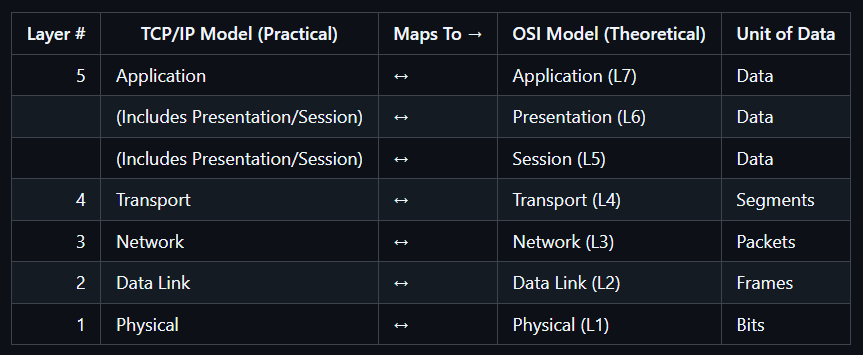
The figure illustrates the relationship between the practical TCP/IP networking model and the theoretical OSI networking model, including their communication layers and corresponding units of data.
Networking Layers Observed
- Application Layer - User-facing services and communication protocols.
- Transport Layer - End-to-end communication and data delivery.
- Network Layer - Logical addressing and packet routing.
- Data Link Layer - Local network communication and frame transmission.
- Physical Layer - Transmission of bits through physical communication media.
Communication Media Reviewed
- Copper Ethernet Cabling (Cat5e, Cat6).
- Fiber-Optic Communication Systems.
- Wireless LAN (Wi-Fi).
- Bluetooth Communication.
- Cellular Networks (4G LTE / 5G).
- Satellite Communication Systems.
Communication Protocols Reviewed
- HTTP and HTTPS for web communication.
- FTP for file transfer operations.
- SMTP, IMAP, and POP3 for email communication.
- DNS for domain name resolution.
- SSH for secure remote administration.
- TCP and UDP for transport-layer communication.
- IP for network-layer packet delivery.
Security Considerations
Security mechanisms operate across multiple layers of the communication process. SSL and TLS provide encryption, authentication, and data integrity for secure communications, while firewalls, VPN technologies, access control systems, and network monitoring tools contribute to traffic protection and cyber threat defense.
Understanding how communication media, protocols, networking devices, and security controls interact provides valuable insight into modern cybersecurity challenges and defensive strategies.
Key Observations
- Modern communication depends on both wired and wireless transmission technologies.
- Networking layers provide structured communication between applications and physical infrastructure.
- Communication protocols define how devices exchange information across networks.
- Security controls operate throughout the communication lifecycle.
- Effective cyber threat defense requires understanding both communication media and protocol behavior.
Future Analysis & Research Direction
This observation serves as an initial foundation for further study, technical analysis, and practical implementation activities related to networking, communication systems, protocol analysis, cybersecurity monitoring, and cyber threat defense methodologies.
Future work may include deeper analysis of network traffic behavior, protocol security assessment, wireless communication security, cloud networking, optical communication systems, and defensive security architectures.
Study Conclusion
Data communication relies on the coordinated operation of communication media, networking protocols, layered architectures, and security mechanisms. Understanding the interaction between these components provides a foundation for analyzing network behavior, improving communication reliability, and supporting cyber threat defense activities in modern digital environments.
This research builds upon previous academic thesis work and industry analytical projects, extending their investigation through ongoing analysis, observation, and independent research.
Future updates may incorporate practical implementations, project outcomes, and professional observations as the research evolves.